
Split
The city of Split and Diocletian's Palace within it
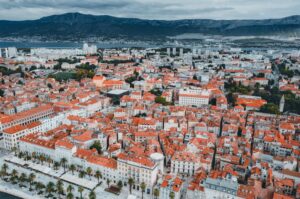
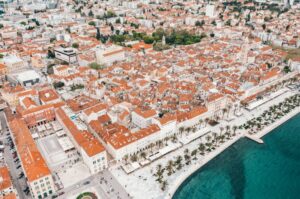
Split, Croatia’s second-largest city, offers a unique blend of ancient heritage and Mediterranean lifestyle. At the heart of this coastal city stands the magnificent Diocletian’s Palace, over 1,700 years old, built by the Roman Emperor Diocletian as his retirement residence and fortress. The palace is virtually a miniature town inside Split: a labyrinth of stone lanes, squares and buildings whose uses have evolved over the centuries while retaining their antique spirit. Strolling through the Peristyle, the palace’s central courtyard framed by colonnades of Roman pillars, you can almost picture emperors parading past, while today visitors relax on the stone steps enjoying the acoustics of this ancient square. From the Peristyle, the tall bell tower dominates the skyline; climbing to the top rewards you with the finest panoramic views over Split, the sea and the nearby islands.
Contents
Add a header to begin generating the table of contents
Diocletian's Palace
Within the walls of Diocletian’s Palace lie several more fascinating monuments: the Vestibule, a monumental entrance hall to the former imperial apartments with an oculus open to the sky, creates a remarkable acoustic effect as its domed vault amplifies even the softest sound. Nearby are the palace Cellars, a network of vaulted subterranean halls and corridors mirroring the layout of the emperor’s chambers above. Today these spacious cellars are open to visitors, hosting exhibitions and souvenir stalls, and fans will also recognise them as a filming location from the hit series Game of Thrones (where the dragons were kept).
Above the Cellars, in the open Peristyle square, visitors will also notice traces of Egyptian art brought here on Diocletian’s orders – a striking reminder of how cosmopolitan Split already was in the 4th century.
Prayer hall (masjid) in Split
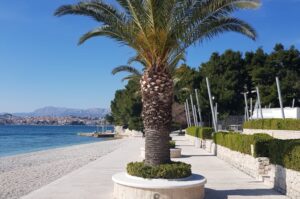
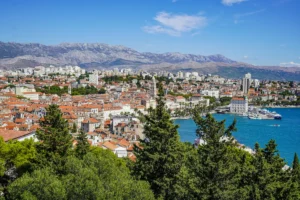
Beyond the ancient palace walls, Split is a lively Mediterranean city lived to the full. Its main seafront promenade, known simply as the Riva, is a favourite gathering place and open-air living room for locals and visitors alike. Lined with palm trees along the water, cafés and patisseries invite you to sit over a Turkish coffee or a refreshing gelato while watching ferries come and go from the nearby harbour. The atmosphere is unhurried, and the backdrop of Diocletian’s Palace and the bell tower of Saint Domnius is particularly memorable at dusk as the sun sinks behind Marjan. Marjan itself is a lush pine-forested hill park at the western edge of Split, beloved for outdoor recreation. Climbing to the Telegrin viewpoint at the summit rewards you with sweeping panoramas over the entire city, the deep blue Adriatic and the islands of Brač, Šolta and Hvar.
Although Split is historically a predominantly Christian city, Muslim visitors can find everything they need for a comfortable stay. Split has a long-established Muslim community organised under the Majlis of the Islamic Community of Split, founded back in 1983. In the city centre (Dominisova Street, right inside Diocletian’s Palace), there is a dedicated prayer hall (masjid) where daily prayers and Friday Jumu’ah prayer are held. That puts visitors in what may be a one-of-a-kind setting anywhere in the world: performing prayer inside the walls of an ancient Roman palace! Plans are also under way to build a larger mosque and Islamic centre in Split with local municipal support, reflecting the city’s openness and multiculturalism, shaped especially by Croatian and Bosniak communities.
Halal food in Split
When it comes to halal dining, Split has plenty to satisfy even the most discerning tastes. Dalmatian cuisine relies on fresh, simple and wholesome ingredients. Almost every restaurant offers an abundance of seafood dishes, and fish is halal under all Islamic guidelines. Be sure to try Dalmatian gregada (a traditional fish stew with potatoes and olive oil) or grilled squid with a squeeze of lemon. Vegetarian classics such as sataraš (a rich vegetable stew) and Swiss chard with potatoes — traditionally served alongside fish — are also widely available. In shops and at the Pazar (open-air market), halal-certified meat can be purchased, as Split has halal butchers serving the local community. Many fast-food outlets across the city, catering to growing numbers of travellers from Muslim-majority countries, offer halal kebab or halal chicken (usually clearly signposted at the entrance). Italian dishes such as pizza and pasta also provide reliable options, alongside abundant fresh fruit, vegetables and seafood at the green market.
Split is a city of sport and outdoor living, so active travellers can join locals jogging or cycling along Marjan Hill. In the evening, a breezy stroll along the Riva past the illuminated boats in the harbour is particularly pleasant. Culture lovers will find events year-round, from open-air film festivals and theatre performances in the authentic setting of the Peristyle to fairs and culinary festivals. Muslim visitors can enjoy these events comfortably, as Split’s general atmosphere is welcoming and family-oriented. Alcohol is present as part of Mediterranean wine culture, yet nobody minds if you choose to avoid it — Dalmatia is well accustomed to visitors of diverse backgrounds and faiths. In fact, with a growing number of guests arriving from Turkey, Arab countries and Malaysia, local hospitality is steadily adapting, from multilingual signage to staff training on halal standards.
The area around Split also offers superb day trips. Just a few kilometres from the centre (by modern-day Solin) lie the ruins of ancient Salona, once the capital of the Roman province of Dalmatia. Wandering among the remains of its Roman amphitheatre, thermal baths and city ramparts brings the scale of the ancient world vividly to life. Rising above Split on a strategic mountain pass overlooking the coast stands the medieval Klis Fortress. A 20-minute drive brings you to the fortress, whose ramparts command magnificent views of Split and the Adriatic Sea. Fans of Game of Thrones will also recognise it as the filming location for Meereen in season four. Visiting Salona and Klis rounds out a stay in Split with a fuller sense of the region’s sweeping history — from Roman foundations to medieval struggles for survival.
